
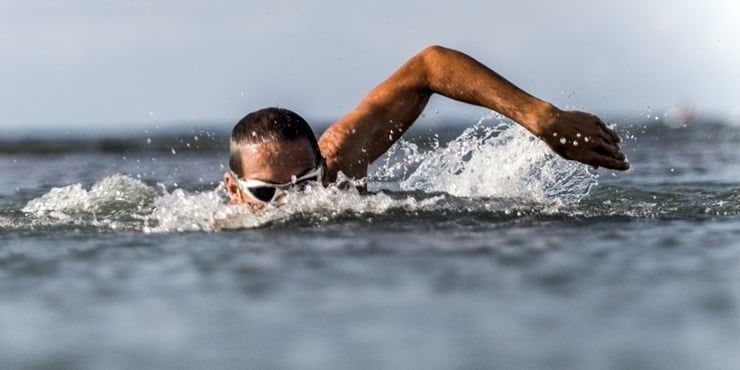
Mastering the Chop Without Breaking Your Neck
Rough open water often exposes a costly habit: lifting the whole head high to search for the next buoy or shoreline landmark. The swimmer feels a brief sense of control, but the price arrives quickly. The chin reaches forward, the neck arches, the hips sink, and the shoulders begin working against extra drag. In choppy conditions, repeating that movement every few strokes can turn a controlled endurance swim into a tense battle with the water.
Effective sighting is not a contest to rise above every wave. It is a timing and positioning skill. A low-profile lift, often called “alligator eyes,” allows only the goggles and forehead to clear the surface. When that small lift is paired with the natural rhythm of the swell and a balanced breathing pattern, the cervical spine stays closer to neutral, the upper shoulders remain quieter, and the stroke continues moving forward. The objective is simple: read the sea, wait for the useful moment, and spend as little energy as possible on each visual check, a principle also reflected in wave-orientation research from lohmannlab.web.unc.edu.
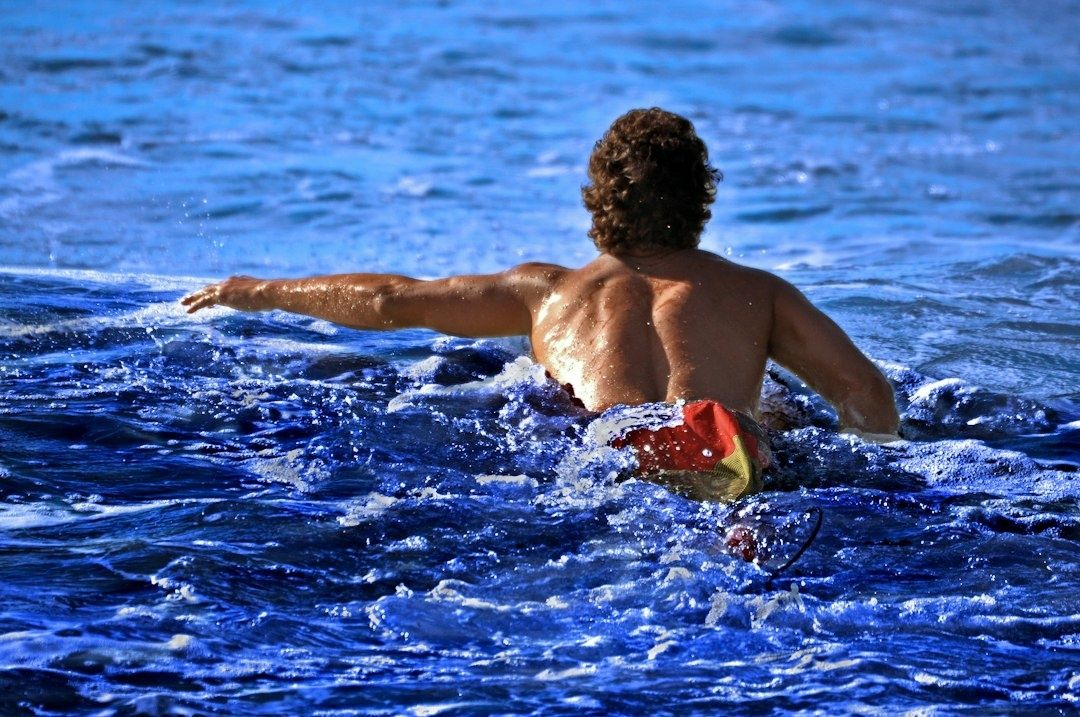
The Anatomy of Neck and Shoulder Burnout in Rough Water
When a swimmer raises the entire head, the body responds as though a lever has been pulled at the front. The chest and hips tend to drop, the legs become less supported by the surface, and the recovering arm may swing wider to maintain balance. At the neck, the movement creates excessive extension rather than a short, relaxed glance. If the wave is still rising, the swimmer may lift even harder, despite having little chance of seeing a reliable landmark through the spray.
The muscles around the neck and shoulder girdle then take over work that should be shared by body position and timing. The upper trapezius elevates the shoulder complex, while the levator scapulae helps stabilize the neck and shoulder blade under repeated load. Cold water and environmental exposure can compound systemic fatigue. Research examining the physiological demands of open-water immersion highlighted how environmental stressors influence deep-body core temperature curves and thermal strain during wetsuited distance swims, as documented in Thermal physiology of open water wetsuited swimming. When thermal strain is coupled with the physical resistance of chop and restrictive neoprene around the shoulder girdle, inefficient sighting mechanics rapidly accelerate localized muscular exhaustion.
This difference becomes clearer when the two approaches are compared. A faulty head lift is large, late, and often repeated in panic. Hydro-efficient spotting is small, timed, and followed immediately by a return to the normal stroke. The second approach does not eliminate effort, but it keeps effort directed toward propulsion rather than holding the head above turbulent water.
| Faulty sighting habit | Hydro-efficient alternative |
|---|---|
| Raises the head and chin high | Clears only the eyes and upper forehead |
| Looks during the wave trough or spray | Waits for the swell crest and clearer horizon |
| Creates a hip drop and wider kick | Maintains a long, streamlined body line |
| Loads the neck and upper trapezius | Shares control through timing, rotation, and core stability |
| Repeats frantic checks | Takes a quick snapshot, then resumes the stroke |
Persistent neck pain, radiating symptoms, weakness, numbness, or pain that changes the stroke should not be treated as normal open-water fatigue. Reduce the workload and seek assessment from a qualified clinician or physiotherapist. Technique corrections, mobility work, appropriate strength training, recovery, and equipment checks are safer than trying to swim through escalating symptoms.
Timing the Swell Crests Instead of Fighting the Troughs
Before spending energy on a sight, read the water from within it. Swells often arrive in recognizable groups, with a sequence of smaller bumps followed by a larger lift. The first few strokes can be used to notice whether the water is building from the left or right, how frequently the crest arrives, and whether the horizon opens briefly at the top. This observation period is valuable because it replaces surprise with expectation.
Sighting in the trough is usually a poor bargain. The swimmer is lower than the surrounding water, so the view may be blocked by the next face of the swell. A hard lift follows, often just as the body is being pushed or rolled by moving water. The result is a blinded stroke, a missed landmark, and a hurried crane-neck movement. Instead, allow the trough to pass and prepare for the moment when the body rises toward the crest. At the apex, even a low lift may reveal enough shoreline, buoy, boat, or distinctive structure to confirm direction.
Natural navigation in open water relies on physical directional cues alongside brief visual checks. Landmark marine research demonstrates that hatchling loggerhead sea turtles orient offshore not by tracking land features or visual horizons, but by swimming directly into oncoming surface waves and swells, as documented in orientation cue research by Salmon and Lohmann. While human swimmers must periodically look up to sight buoys or course gates, reading the rhythm and angle of the swell beneath the body can provide ongoing directional feedback, reducing the need to crane the neck on every stroke.
- Study the swell direction and visible landmarks before starting.
- Choose a large target, such as a headland, tower, high shoreline feature, or prominent buoy.
- Use the rising crest to create a brief viewing window.
- If the view is blocked, keep the stroke calm and wait for the next useful lift.
- Recheck the course regularly, especially after a turn, current change, or crowded section.
Conditions still set the limit. Breaking waves, rocks, strong currents, boat traffic, and poor visibility can make a technique problem into a safety problem. Train in conditions appropriate to current ability, avoid entering water that exceeds the planned skill level, and follow local guidance. A tow float, a training partner, and a clear exit plan add practical protection when visibility or weather deteriorates.
Executing Low Profile Alligator Eyes for Minimal Drag
Alligator eyes are effective because they solve the navigation problem with the smallest possible interruption to body position. The movement should feel closer to peeking over a low wall than sitting up in the water. Keep the neck long, avoid jutting the chin, and let the wave support the visual check. The following sequence can be practised first in a pool, then in progressively more active open water.
- Press the chest down slightly. As the lead arm extends, apply a subtle downward pressure through the upper chest and supporting arm. This helps lever the eyes toward the surface without throwing the head backward. The hips should remain near the surface, with the kick compact rather than frantic.
- Clear the goggles and forehead only. The mouth can remain submerged. There is no need to expose the nose, jaw, or entire face. Keep the gaze forward and low, allowing the wave crest to provide the elevation that a large neck extension would otherwise create.
- Take a snapshot. Scan for the selected landmark in less than half a second. Do not try to study the entire horizon. A quick confirmation of direction is enough, especially when the course has already been memorised and landmarks have been chosen in advance.
- Roll directly into bilateral breathing. After the glance, return the face to the water and rotate through the torso into a controlled breath on either side. This prevents the neck from staying twisted while the stroke continues under load.
The movement should be practised with a relaxed exhalation rather than a held breath. A swimmer who holds air while lifting often tightens the jaw, neck, and shoulders at the exact moment coordination is needed. Start with sighting every six to ten strokes in calm water, then vary the interval and add gentle turbulence. The aim is not to create a rigid count, but to make the visual check familiar enough that rough water does not trigger a large emergency lift.
Goggles also matter. Leaking or fogging lenses encourage repeated, exaggerated lifts and longer glances. Check the seal, visibility, and strap position before entering the water. In a wetsuit, make sure the neck opening does not create a choking sensation or restrict rotation. Equipment that fits well reduces the temptation to compensate with the head and shoulders.
Integrating Bilateral Breathing and Cadence to Hold Your Line
Unilateral breathing can become a problem in cross-chop when every breath is taken toward the same side. The repeated rotation may pull the spine away from neutral, while waves striking the breathing side encourage the swimmer to lift the head or shorten the stroke. Bilateral breathing gives the swimmer more options: breathe away from spray, check both sides of the course, and distribute rotational work across the body.
Bubble breathing is a practical foundation. Exhale steadily into the water as soon as the face returns after a breath, rather than waiting until the next rotation. A quiet stream of bubbles prevents breath-holding, reduces the rush to inhale, and supports a softer neck and shoulder position. In turbulent water, the inhalation may need to be brief, but it should remain controlled. If chop repeatedly interrupts breathing, slow the stroke slightly, maintain a compact kick, and regain rhythm before increasing speed.
- Use a relaxed bilateral pattern in training, such as breathing every three strokes when conditions allow.
- Switch sides when glare, spray, current, or waves make one direction less practical.
- Anchor sighting to a repeatable rhythm, such as a quick check every six to twelve strokes, then adjust for course demands.
- Practise alternating lengths with sighting and no sighting in the pool to learn how much visual information is actually required.
- In open water, confirm direction after turns and whenever the landmark disappears, rather than sighting continuously.
A useful drill is the three-part navigation set. Swim normally for several strokes, perform one low-profile sight, then take the next breath bilaterally while keeping the stroke length intact. Repeat first in calm water, then with a partner creating small surface disturbances. Another option is to practise sighting on the approach to a floating marker, selecting the marker before the repetition begins. These drills teach the body that sighting is a brief addition to the stroke, not a separate movement that stops propulsion.
Training should include conditions that resemble the planned event, but exposure must be progressive. Open-water guidance recommends rehearsing sighting, rough-water responses, starts, turns, drafting awareness, and course navigation before race day. Never train alone in hazardous conditions. Check the forecast, understand local currents and exits, tell someone the plan, and use visible flotation where appropriate.
Claim Your Line and Own the Open Sea
Efficient rough-water sighting rests on three connected skills. Time the lift with the crest instead of fighting the trough, use alligator eyes to expose only what is needed for a visual check, and maintain a bilateral rhythm that keeps the neck and shoulders from carrying the entire navigation load. Together, these choices preserve body line, reduce drag, and keep the stroke productive when the surface becomes irregular.
Calmness is not merely a mental bonus; it changes mechanics. When the swimmer expects the swell, exhales continuously, and trusts a large landmark, the upper trapezius does not need to brace against every splash. Before the next open-water session, rehearse the sequence in a controlled setting, select a clear course reference, and build gradually toward the expected conditions. Let the sea provide the lift, take the smallest useful look, and keep moving with steady control.